There’s a lot of noise about what happens when you quit drinking. The wellness industry loves a good before-and-after story: glowing skin, eight hours of sleep, a sudden ability to run a 5K, £300 saved, basically becoming a better version of yourself by day 14. It’s all very motivational and mostly bollocks.
The truth is messier and more interesting. A month sober does change things. Just not always in the way you’d expect, and definitely not all at once.
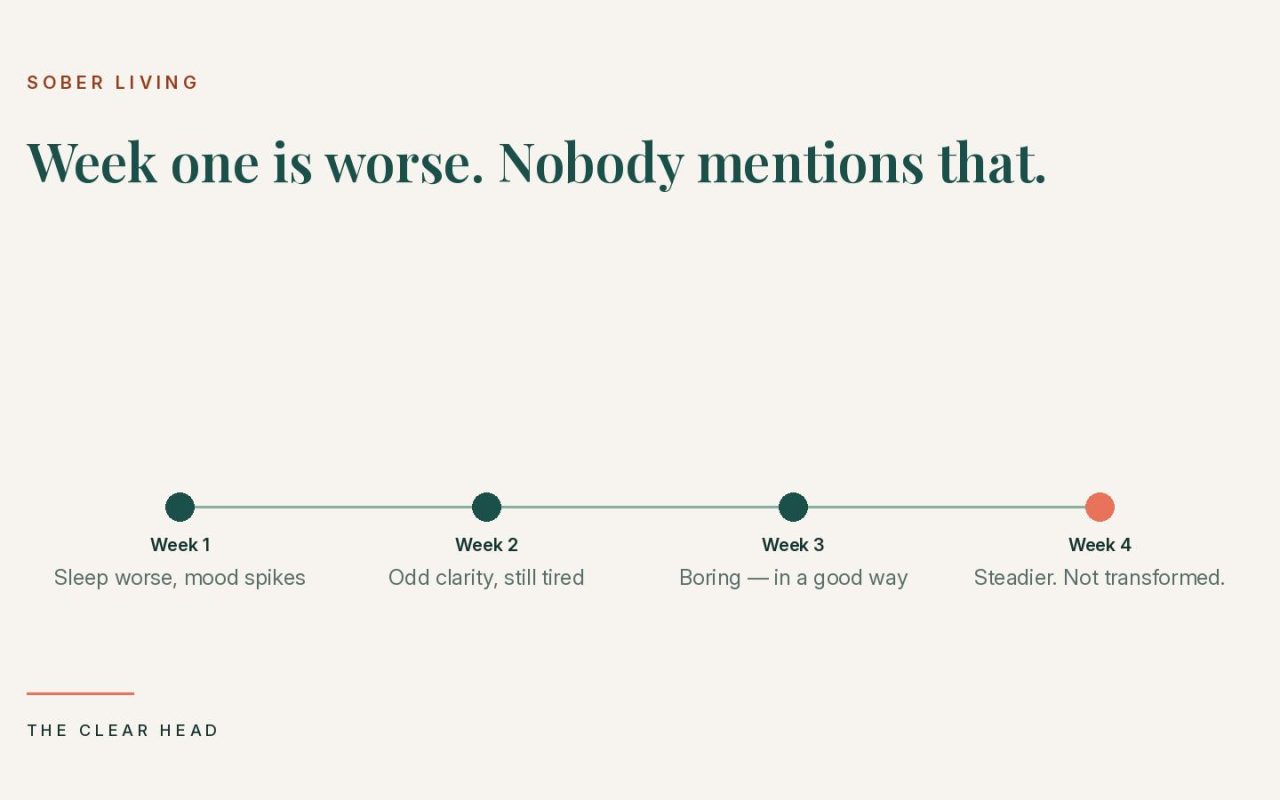
Week One: You Feel Worse, Not Better
This is the part nobody warns you about properly. Your body’s been using alcohol as a depressant and a sleep aid for however long. Remove it suddenly and you don’t sleep better immediately. You sleep worse. You’re wired at 2am, then exhausted at 6am, then wired again at 10pm. Your mood swings are spectacular. You’re irritable, anxious, a bit foggy.
Your skin doesn’t glow. It looks angry. You might break out worse than you have in years. Your digestive system’s confused. You might feel genuinely unwell for a few days, especially if you were drinking heavily.
This is dehydration and withdrawal, even mild withdrawal. Your nervous system’s recalibrating. It sucks. But it does pass.
Week Two: The Weird Clarity Window
Around day 8 to 10, something shifts. Not in a magical way. Just in a “oh, I can actually think in the mornings” way. You remember conversations. You don’t spend the first two hours of the day reconstructing what you said to someone at 11pm.
Your sleep’s still erratic, but you notice the sleep you do get feels deeper. Not eight perfect hours. Maybe six solid ones and three rubbish ones. But the solid ones feel different. You wake up without that thick, fuzzy hangover feeling even if you don’t feel brilliant.
Mood-wise: you’re less anxious, but you’re also more aware of your anxiety. When you were drinking, you were self-medicating without noticing. Now you notice. Some people find that harder than the drinking itself.
Money-wise, the maths is obvious and depressing. A £5 bottle of wine every night is £35 a week, £150 a month. A couple of pints three times a week at £5 each is £30 a week, £120 a month. Add in the rounds, the fancy cocktails, the drunk Uber home, and it’s easily £200-300 a month for a moderate drinker. You’ll see that money sit in your account and feel weird about it. Like you’ve found money you didn’t know you had.
Week Three: The Boring Bit
This is where the real change happens, and it’s completely unglamorous. Your sleep normalises. Not perfectly. You’re still waking up at 5am sometimes. But you’re sleeping seven hours most nights. You’re not waking up in a panic. Your dreams are vivid and sometimes weird, which is normal when your REM sleep comes back properly.
Your skin starts to improve. Not dramatically. You’re not going to look ten years younger. But the inflammation goes down. You’re less puffy in the face. Your skin texture improves slightly. If you were getting regular spots from dehydration and poor sleep, those start clearing. But you’re also just noticing your actual skin for the first time in ages, so the improvement feels bigger than it is.
Energy levels are steadier. You’re not crashing at 3pm. You’re also not buzzing at midnight. You’re just… more consistent. Which is less exciting than it sounds but genuinely useful when you’re trying to get things done.
Mood-wise: you’re more stable. Less dramatic. Less of the highs and lows. Some people find this boring. Some find it a relief. You’ll probably find it both, depending on the day.
Week Four: The Honest Assessment
By day 30, here’s what’s actually different:
You’re sleeping better. Not perfectly, not eight hours every night, but consistently better. You’re probably sleeping six to seven hours most nights instead of five to six, and the quality is genuinely improved. You’re not waking up in a sweat. You’re not reaching for your phone at 4am in a panic.
Your skin is better. Not glowing. Not transformed. But clearer, less puffy, less inflamed. If you were a heavy drinker, the improvement is more noticeable. If you were a moderate drinker, you’ll notice you look slightly fresher. That’s it.
Your mood is more stable. You’re less anxious on the whole. You’re also less able to ignore your actual problems, which is good and annoying in equal measure. The anxiety you were drowning out is still there. But you’re dealing with it instead of postponing it.
Your bank account has an extra £150-300 in it. This is real and genuinely nice.
What Doesn’t Change
Here’s what the wellness industry won’t tell you. Your life doesn’t magically improve. You’re still you. You still have the same job, the same relationship problems, the same tendency to procrastinate, the same anxiety about your future. Alcohol wasn’t the reason your life was stuck. It was just making it easier not to notice.
You don’t automatically become more productive. You don’t suddenly run marathons. You don’t become a different person. Some people do find they have more energy and motivation. Some people just feel less terrible and that’s the whole benefit.
You don’t stop wanting a drink. You stop wanting it every day. You stop wanting it every hour. But by day 30, you’ll probably still have moments where you think “a glass of wine would be nice right now”. That doesn’t mean you’ve failed. It means you’re human.
Social situations don’t automatically become easier. You’re still awkward at parties. You’re just awkward and sober, which is actually harder because you can’t blame the alcohol for how weird you feel.
So Is It Worth It?
Yes. Not because you’ll look like a different person or feel euphoric. But because better sleep, clearer thinking, more stable mood, and an extra £200 in your account is genuinely valuable. Because you’ll know what you actually think and feel without alcohol softening the edges. Because you’ll have one month of evidence that you can do something difficult.
It’s not life-changing. It’s just… better. And sometimes that’s enough.
Compliance Note: This article is for informational purposes only and should not be considered medical advice. If you’re concerned about alcohol withdrawal or your health, please consult a healthcare professional before making significant changes to your drinking habits.